Hello. I’m Vadim Jourdan.
Marketer, product person, entrepreneur, sailor, and recently the father of a rather charming daughter. Living in Lisbon, Portugal, since 2022.
I help projects grow where marketing, product and AI meet.
Get in touch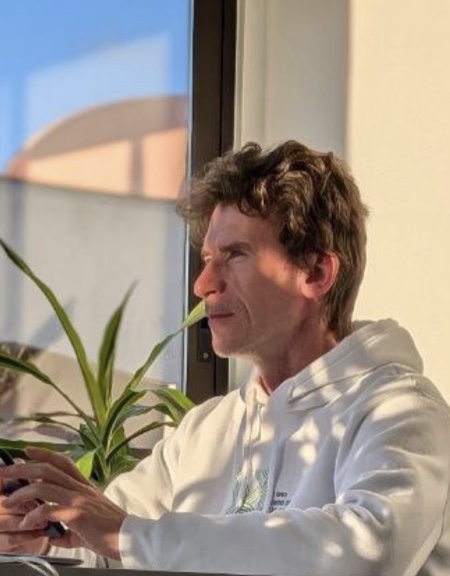
Path
Marketing and advertising
I started in advertising and marketing: retail, wine and spirits distribution, publishing, a private clinic network. Different markets, one recurring question — how do you explain to a person why you are worth choosing. Sommelier training came from that period, as did a few years publishing restaurant guides.
Building companies
Then came the entrepreneurial years. I founded and grew Storm Crew, a yacht trip marketplace, and later sold it. I went through Founder Institute, coached startups as a tracker, was a partner at Today®, a strategy consultancy, and co-founded KIT, a system for building flexible office spaces.
SEARADAR
A few years ago I joined SEARADAR, a European yacht charter marketplace, as a partner and CMO. More recently I moved into the product owner role and now work on the product and AI transformation of the company.
Now
Alongside that, I help other projects with growth.
It almost always turns out that a company has already produced all the evidence of what isn’t working. It sits in how search engines and assistants answer questions about them, in their own correspondence with customers, in the experience they sell every day. Until recently there was simply no way to read that volume: nobody reads four thousand conversations or hand-checks a hundred assistant answers. Now you can, and that is the only reason this kind of work exists at all.
I read that evidence and turn it into a short list of decisions.
How I help
Four steps, from the outside in. Each one asks you to let me a little deeper — and answers a slightly bigger question.
Visibility
Your category already has a settled answer. It is assembled from sources you did not choose, and it is repeated to thousands of people every day — in search results, in ChatGPT, in Google’s AI overview. I work out what that answer is built from, where you are missing from it, and why.
The measurement itself is the easy part, and you could genuinely hand it to a contractor. The hard part comes after: of twenty gaps found, three are worth closing, and which three is decided by your economics rather than by the size of the gap. What you get is those three, written so your team can start on Monday.
Conversations
Your best sales playbook is already written. It is sitting in the threads of the deals you won — nobody has ever taken it out of there.
I go through the body of your real customer conversations and look for what happens systematically: where replies arrive too late, which question turns up in every second thread, at which step the conversation goes quiet, what your strongest salesperson does that nobody else does. Then come the corrections to the sales process: what to change in the rules and scripts, what to take off people and automate, what has to stay human. If a correction needs building, I write the specification or build the first working piece myself.
Experience
The one step where AI is no use at all. A machine cannot feel the moment a place stops being generous. A person feels it in a second.
I walk your customer’s path the way your customer walks it: the site, the correspondence, the venue, the product in hand. Years around hospitality, sommelier training and a decade of skippering teach you to notice not what is broken but what simply fails to delight. What you get is a verdict with priorities: where you lose goodwill, what it costs you, and what to change first. Implementation stays with you.
Decisions
Funnel, metrics, priorities. What to measure, what to fix first and what to drop. More often than not this is a conversation about focus rather than about new features.
People rarely start here, and rightly so: decisions without evidence are guesswork. One or two of the steps below usually produce enough material to make this conversation worth its price.
How we work
A conversation
An hour or so of talking, and a short written summary with next steps afterwards. A good way to work out which of the four steps is worth starting from.
A project
Fixed scope, fixed timeline, a document or a working piece at the end. Usually a week or more.
Ongoing
A few hours a week, three months and up — a fractional CMO or product advisor, depending on what needs holding. For companies that need the whole picture held rather than a single question answered.
Terms are agreed and fixed in the first conversation.
Beyond work
Sailing
I got into sailing around 2010, took my licence, and have been skippering ever since. Most of the Mediterranean, Turkey, Ireland, the Seychelles, Thailand — and a lot of very different crews on board. What I like most is not the passages themselves but the moment someone takes the helm for the first time and realises this is their thing.
Taste
The distribution years left me with sommelier training and a lasting weakness for natural wine. Add specialty coffee, electronic music, and a soft spot for places built with real respect for the guest. An occupational deformation from years spent around hospitality.
Making things
I like building things myself: interfaces, automations, small tools for my own problems. Not quite a hobby — more a way of understanding how things actually work from the inside, rather than from someone else’s account of it.
Let’s talk
Write me a couple of sentences about where the difficulty is right now. I’ll tell you whether I can help. If it isn’t my kind of problem, I’ll say so, and point you somewhere better if I can.